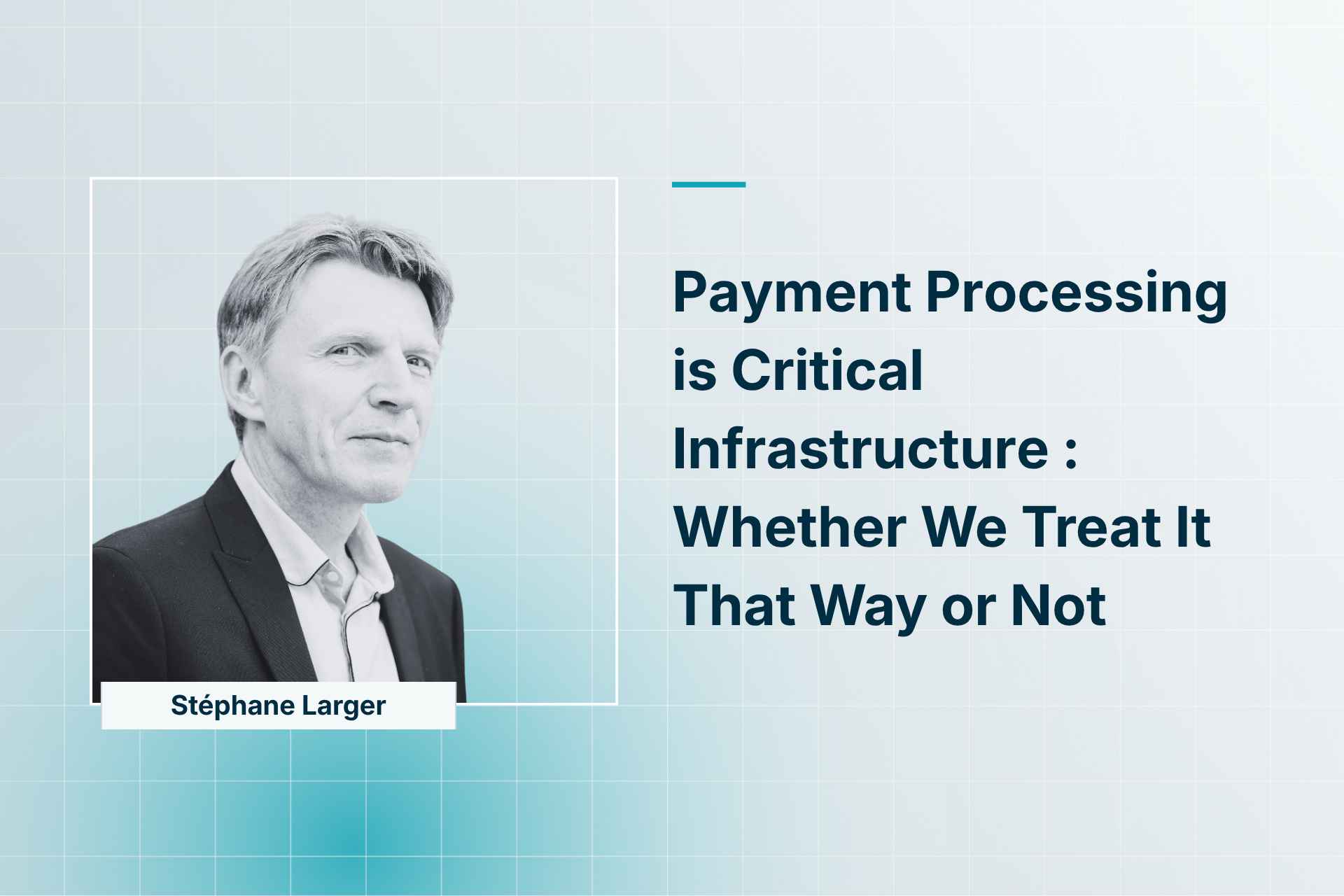
Payment Processing Is Critical Infrastructure: Whether We Treat It That Way Or Not

For a long time, payment processing has been perceived as a technicallayer: essential, certainly, but ultimately interchangeable, something that operates in the background without ever becoming the object of strategic attention. It was infrastructure in practice, but not in the way it was thought about.
That distinction is beginning to collapse.
Why payment processing has become a strategic infrastructure
Because what we call “payment processing” is not simply the execution of a transaction. It is the orchestration of trust across a network of actors that rarely interact directly with one another yet depends on each other in real time. A customer initiates a payment, a merchant expects certainty, a bank evaluates risk, a scheme enforces rules, and a processor ensures that all these expectations converge within a few hundred milliseconds, without friction, without ambiguity, and without failure.
When everything works, the system disappears entirely. It becomes invisible by design, absorbed into the flow of everyday life. But this invisibility is deceptive. It does not signal simplicity; it signals stability. And stability, at this scale, is not a natural property; it is engineered.
The moment something breaks, even briefly, the illusion dissolves. Transactions fail, queues build up, customer journeys are interrupted, and the consequences propagate far beyond the initial fault. What appears to be alocalized technical issue reveals itself as a systemic dependency. This is the defining characteristic of infrastructure: not its presence, but the impact of its absence.
Across Europe, a significant part of this infrastructure is built on layers that are not fully controlled locally. This does not necessarily create immediate disruption, which is precisely why it often remains unchallenged. Dependency in infrastructure rarely manifests as a sudden rupture. It takes the form of gradual constraint, shaping what can be built, how fast systems canevolve, and where control ultimately resides.
Rebuilding processing capabilities in this context is not about withdrawing from existing ecosystems, nor about replacing one dependency with another. It is about regaining the ability to make architectural decisions that align with local constraints, regulatory expectations, and long-term strategic objectives. It is, fundamentally, an industrial question.
Building systems that remain reliable under constant change
At the same time, the environment in which these systems operate has changed in ways that legacy architectures were not designed to absorb. Payment systems were historically optimized for stability in a relatively predictableworld, where transactions could be grouped, processed in batches, unreconciled after the fact. Today, expectations have shifted toward immediacy, continuous availability, and real-time visibility. Systems are no longer allowed to “catch up” — they are expected to be consistent at every moment.
This transformation introduces tension that cannot be resolved through incremental change alone. Systems must evolve continuously, but they must do so without compromising their integrity. They must become more flexible without becoming more fragile. They must integrate more dependencies while maintaining control.
Designing these constraints requires a different engineering posture. Itis no longer sufficient to optimize individual components. What matters is the behavior of the system as a whole, under normal conditions as well as under stress. Reliability ceases to be a performance metric and becomes a design principle. Observability is no longer a tool but a necessity. Deployment is not an event but a continuous process.
In that sense, treating payment processing as infrastructure is not a matter of definition. It is a recognition of what it already is. The real question is whether we choose to design it accordingly.
Go behind the scenes of modern payment processing.
Discover how critical infrastructure is built, operated and scaled.