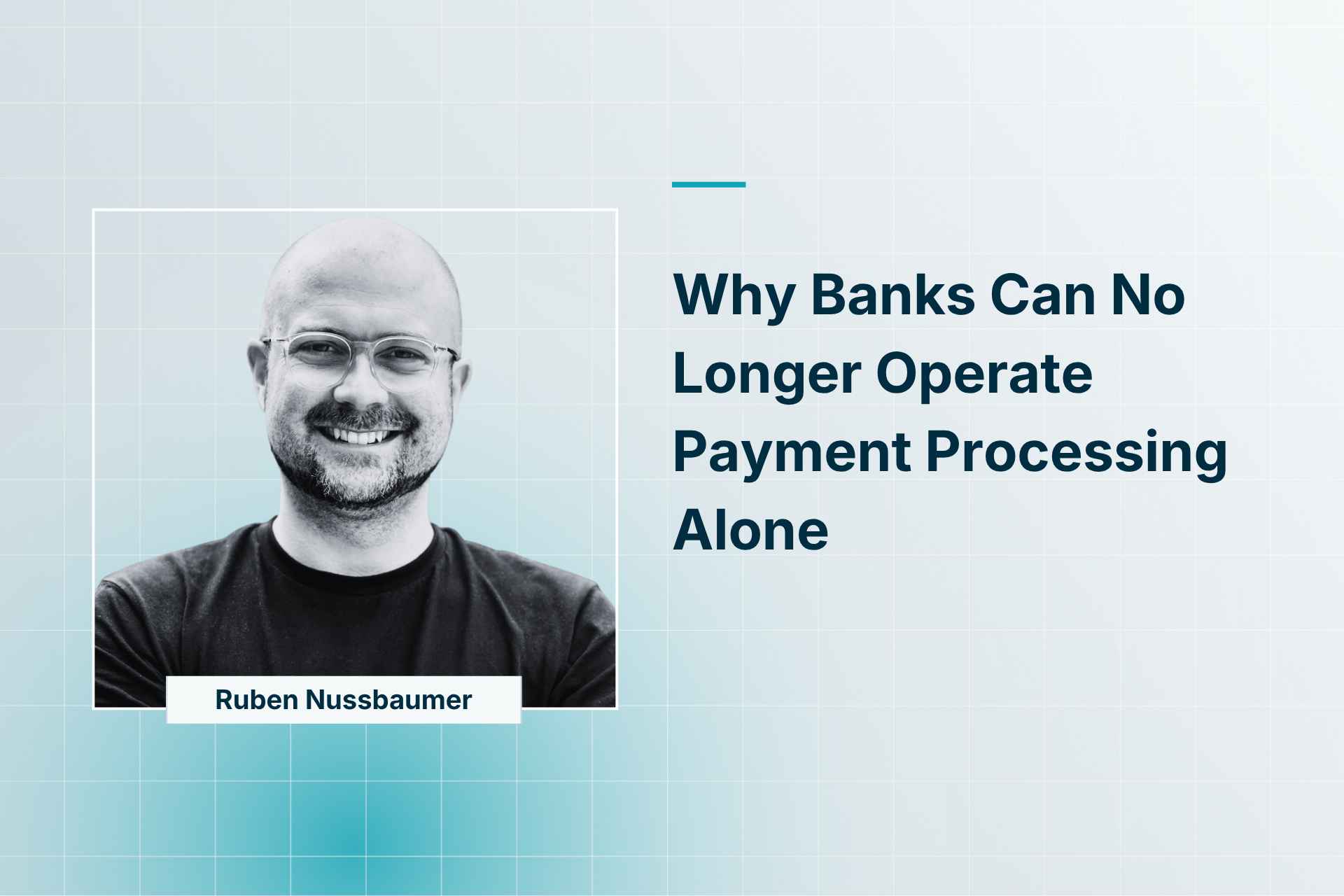
Why Banks Can No Longer Operate Payment Processing Alone

For decades, banks have been at the center of payment processing. They owned the systems, operated the infrastructure, and controlled the flows. Processing was considered an extension of their core operations, deeply integrated into their IT environments and aligned with their internal processes. This model was coherent in a world where complexity was contained, payment methods were more limited, and technological evolution was relatively slow.
That world has changed.
The rise of complexity
Payment systems have become significantly more complex over time. They must now integrate with multiple schemes, support a growing number of payment methods, comply with evolving regulations, and operate across different geographies and channels. At the same time, expectations around performance, availability, security, and user experience have increased.
Managing this complexity requires specialized expertise, continuous investment, and the ability to evolve systems rapidly without compromising stability. For many banks, this creates a structural challenge: payment processing is no longer only a matter of operating critical infrastructure, but of continuously adapting that infrastructure to new market, regulatory, and technological requirements.
The limits of internal models
Traditional banking IT models are not always designed to support this level of dynamism. Systems are often organized around long development cycles, strict change management processes, and architectures that prioritize stability over flexibility. While these characteristics remain essential for many banking operations, they can become limiting when systems need to evolve continuously and respond quickly to new requirements.
Payment processing sits precisely at the intersection of these constraints. It requires both stability and adaptability, both control and speed, both operational robustness and continuous innovation. Reconciling these requirements within traditional models is becoming increasingly difficult, especially as payment infrastructure becomes more industrial, more real-time, and more interconnected.
The emergence of specialized actors
This context has led to the emergence of specialized processors, designed to handle the complexity of payment systems at scale. These actors focus on building platforms that are modular, scalable, resilient, and continuously evolving. They invest in dedicated payment expertise, modern architectures, and operational models aligned with the requirements of high-volume, real-time processing.
Their role is not to replace banks, but to complement them. As payment infrastructure becomes more complex and more demanding, specialized processors provide the technological and operational capabilities required to support critical payment services, while banks continue to own the relationship with their clients and the broader financial services they provide.
A shift in roles
As payment processing becomes more complex, banks are not stepping away from their core role, but rather redefining how they exercise it in a more specialized ecosystem. Their expertise remains focused on money management, client relationships, commercial strategy, and the ability to provide trusted financial services to merchants and customers. What is changing is the level of technical complexity required to operate the infrastructure behind these services.
In this context, banks increasingly rely on technology partners that are able to master this complexity at scale, while preserving their own control over the relationship with clients and the value proposition they bring to the market. Complex money management remains their job; complex technology management can be supported by specialized actors whose role is to provide resilient, secure, and continuously evolving processing infrastructure.
This shift should therefore not be understood as a loss of control, but as a more efficient distribution of responsibilities. Banks continue to define the financial experience, the commercial relationship, and the strategic direction, while specialized processors provide the industrial capabilities needed to support payment services that have become increasingly demanding in terms of performance, availability, compliance, and speed of evolution.
The importance of integration
This new model requires strong integration capabilities. Banks must be able to connect to external platforms, configure services according to their operational needs, and maintain visibility over how transactions are processed. This creates new requirements around APIs, data flows, governance, monitoring, and interoperability.
The ability to integrate efficiently becomes central. For banks, the objective is not to multiply bespoke developments or rebuild complexity in another form, but to rely on standardized foundations that can be configured and connected to their own environments. In this sense, integration is not only a technical topic; it is what makes the model viable, scalable, and compatible with the level of control expected by financial institutions.
Toward platform-based processing
Over time, payment processing is moving toward platform-based models, where infrastructure is shared, standardized, and continuously improved. These platforms are not built as bespoke systems for each institution. Their value lies in their ability to industrialize complexity by providing robust, standardized foundations that can be configured and integrated into different banking environments.
For financial institutions, this means accessing payment infrastructure that combines resilience, compliance, performance, interoperability, and scalability, without multiplying specific developments. It represents a different way of thinking about processing: not as a fully internal system, but as a standardized service that can be consumed, configured, and integrated.
This approach allows payment infrastructure to evolve more efficiently over time. Improvements can be deployed across the platform, regulatory changes can be addressed in a more industrialized way, and banks can benefit from continuous innovation without having to carry the full technological burden alone.
A structural transformation
This evolution is not driven by technology alone. It reflects a broader transformation in how financial systems are organized. Processing is becoming an industry in itself, with its own actors, its own standards, and its own dynamics.
Banks remain central to this ecosystem. They continue to own the client relationship, the financial proposition, and the trust that underpins payment services. But they are no longer alone in operating the technological infrastructure required to support them. As payment systems become more complex, more real-time, and more demanding, the future of processing will increasingly depend on the ability of banks and specialized technology partners to work together, each focusing on the role where they create the most value.
Dans les coulisses du processing des paiements
Découvrez comment les infrastructures critiques sont conçues, opérées et mises à l’échelle.